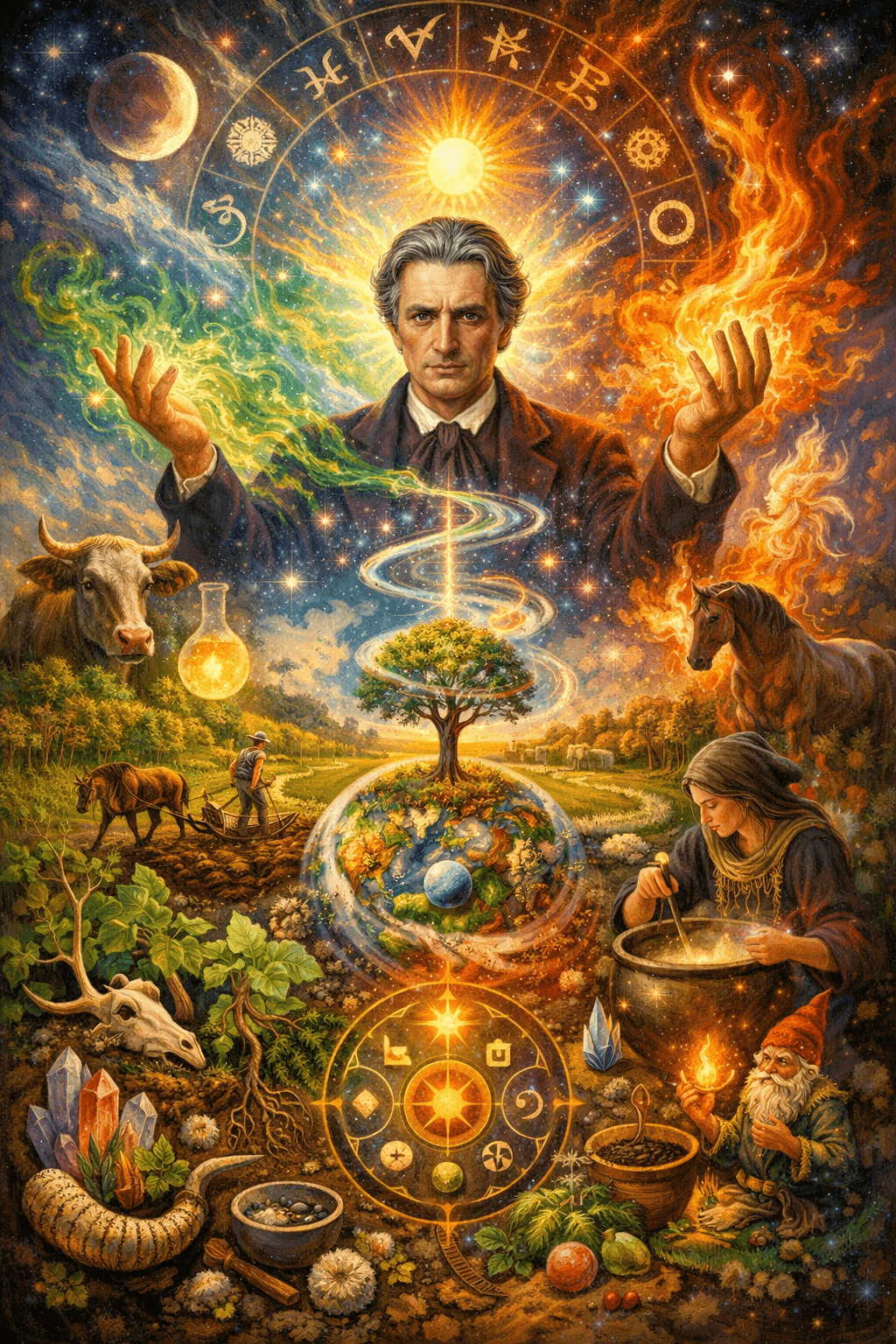
Rudolf Steiner & Biodynamic Agriculture
Rudolf Steiner and Biodynamic Intuition
Competing ideas at the edge of early agricultural science
As agricultural chemistry and soil science were becoming more formalized in the early 20th century, not all serious thinkers moved in the same direction.
Alongside laboratory chemistry, field trials, and emerging industrial agriculture, there existed competing frameworks—attempts to describe life, soil, and plant health that did not yet have a complete scientific vocabulary, but were deeply rooted in observation.
One of the most influential—and most controversial—of these figures was Rudolf Steiner.
An outsider to formal agricultural chemistry
Steiner is often excluded from traditional agricultural histories, particularly those centered on chemistry, yield optimization, or what later became conventional agriculture.
This exclusion is understandable.
Steiner was not a soil chemist. He did not work within the emerging frameworks of nutrient analysis, base saturation, or pH. His language was philosophical, symbolic, and at times difficult to reconcile with reductionist science.
And yet, dismissing him entirely misses something important.
Competing ideas, not opposing intent
Steiner’s agricultural lectures—later forming the foundation of biodynamic agriculture—were offered at a time when:
- chemistry could measure nutrients but not relationships
- biology was observed but poorly explained
- soil life was known to matter, but not how or why
Steiner was attempting to describe patterns he could see, using the intellectual tools available to him.
His intent was not anti-science. It was pre-scientific in the literal sense: before the tools existed to translate intuition into measurement.
Biodynamics as early systems thinking
At its core, biodynamic agriculture emphasized:
- the farm as a self-regulating system
- soil vitality as foundational to plant health
- the interdependence of soil, plant, animal, and environment
These ideas now sound familiar.
Modern systems biology, agroecology, and soil food web science echo many of the same principles—though expressed with data, microscopy, and molecular tools rather than metaphor.
Steiner lacked a shared scientific language. But he was not lacking perception.
Where the language fell short
Many of Steiner’s concepts were expressed through:
- cosmic rhythms
- energetic forces
- symbolic preparations
To modern ears, this language can obscure rather than clarify.
But it is important to remember the context.
Microbial ecology did not yet exist. Enzymes were poorly understood. DNA was undiscovered.
Steiner was trying to articulate biological complexity without a biological vocabulary.
Intuition ahead of instrumentation
From a modern perspective, it is reasonable to say that Steiner was intuitively tracking phenomena that science would later explain.
Soil life. Biological mediation. The importance of structure and vitality beyond chemistry alone.
Had Steiner lived in an era of genomic sequencing, soil respiration assays, and microbial profiling, his work would likely have looked very different.
One can reasonably imagine him as a scientist delighted by tools—testing, measuring, refining rather than relying on metaphor.
Why Steiner belongs in this series
This series is not a ledger of who was right or wrong.
It is a record of how understanding evolved.
Steiner represents a parallel path—one that did not dominate policy, industry, or formal science, but persisted because it addressed something chemistry alone could not yet explain.
His work stands as evidence that:
- there were competing ideas about soil health
- reductionism was not universally accepted
- intuition often precedes explanation
Bridging intuition and evidence
Modern soil science increasingly validates principles Steiner emphasized:
- systems matter
- life mediates chemistry
- soil vitality cannot be reduced to inputs alone
What has changed is not the direction of inquiry—but the tools.
Today, those tools allow us to translate intuition into data, and philosophy into testable frameworks.
Steiner’s contribution, then, is not a blueprint.
It is a reminder.
That science does not move forward in a single line. That insight often appears before language. And that progress is sometimes recognizing what someone was trying to say, even when they could not yet say it clearly.
Setting the record straight
Including Steiner here is not an endorsement of every method or metaphor associated with biodynamics—but it is a salute to a man who spoke about soil the way a psychedelic steampunk wordsmith might: vividly, intuitively, and far ahead of the instrumentation of his time.
It is an acknowledgment that agriculture has always contained multiple ways of knowing.
Some paths gained instruments. Others preserved intuition.
The work ahead is not choosing between them—but learning how to integrate what each was reaching toward.
Next, we will continue forward into how modern science finally acquired the tools to explain the biological mediation that thinkers like Steiner could sense—but not yet measure.